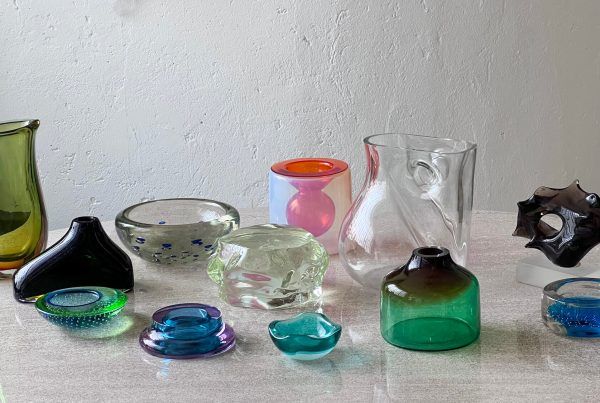

Everybody knows it: it’s almost impossible to say glass without thinking of Murano. For almost eight centuries, the Venetian island has been home to the most respected makers on the planet, and Murano glass has since been eponymous with flawless quality. Well aware of the value of this art, the Venetian Republic went as far as prohibiting the emigration of its glassmakers, inflicting severe punishments on whoever tried to sneak out secrets of the craft.
The everlasting success of Murano Glass was made possible by the joint efforts of all the glassmakers based on the island; some of them, however, stand out in the crowd thanks to the unique characteristics of their works – innovation, quality unicity. In this article, you’ll find our selection of ten relevant makers.
Modern Murano glass: the 20th century
But let’s start with a little historical context: starting from the 1930s, several makers began hiring architects and designers as artistic directors: the natural result of this combination of craftsmanship and vision was a new season for the Murano glass industry and culminated in the invention of new styles and techniques. Vases, bowls, sculptures and in general objects created during the Mid-Century era are extremely attractive, and still today command the attention of passionate collectors and enthusiasts.
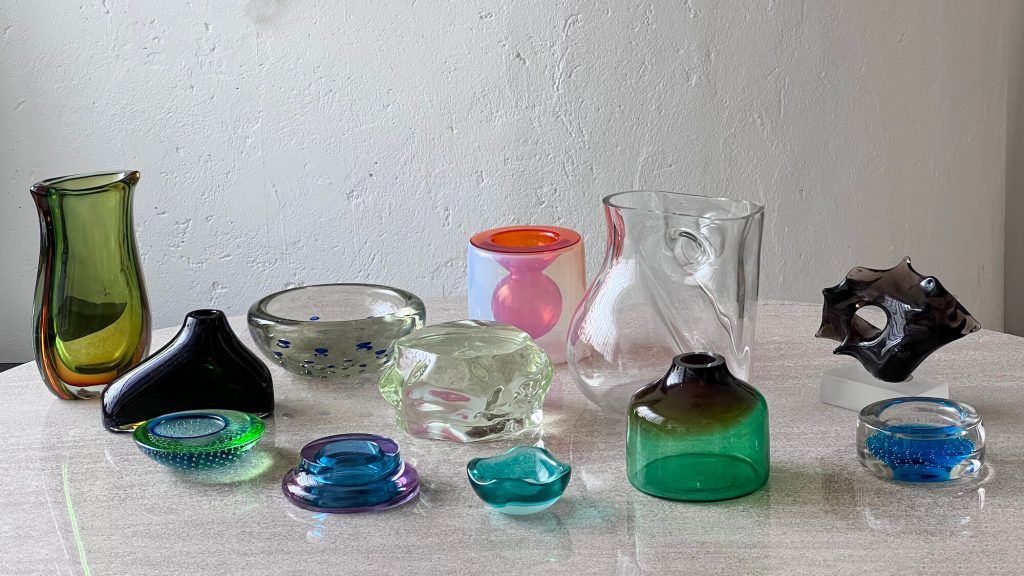
Today, a mere sixty furnaces remain active on the tiny island, giving jobs to over a tenth of its population; back in the days, however, the number was way larger – above 300 for the best part of the Twentieth century. Their work could fill entire books, but for this article, we’ve decided to single out our ten favourite makers, and of course, offer a glimpse into their craft. So, here are ten legendary Murano Glass makers!

Barbini
Like many (possibly most) furnaces on the island, Barbini bore the name of its founder – Alfredo Barbini. Its founder had an interesting career: at the age of 20, he became the master glassmaker at Zecchin & Martinuzzi; he went on to work at VAMSA and Cenedese to eventually open his own workshop in 1950. At Barbini, he specialised in the production of thick glass, often decorated in the “Bullicante” technique, obtained with the inclusion of tiny air bubbles in the glass fuse during the creation of the piece.
Seguso
Talking of Seguso is almost the same as talking of Murano Glass itself: the family was indeed amongst the first to set up a glassmaking workshop on the island, with written proof dating as far back as 1397. Rooted in innovation and research, the Seguso name has always been associated with new techniques and styles: they introduced the “Filigrana” during the 18th century, and the “Sommerso” was developed by Flavio Poli during his time as art director for Seguso. Amongst their creation, the “Merletto” bowls are certainly the most impressive and valuable.


Barovier
One of the (very few) makers who can rightfully claim to be older than Seguso is Barovier: with a foundation act dated 1295 – a mere four years after the Venetian Republic displaced all glassmaking workshops to the island of Murano – Barovier is indeed the oldest still in operation. If that wasn’t enough, it’s even ranked as the sixth oldest family-run business in the entire world. The age of the company should be a clear hint that Barovier likely crafted all different kinds of Murano glass, but the one they’re most famous for is probably the “Rostrato”, a (usually) clear glass with spikes spread all over the surface. Apparently old-fashioned, the Rostrato is highly decorative and still very appreciated today; it often finds a spotlight in contemporary interior decoration projects.
Venini
Given the aura of its name, one might think that Venini has a millenary tradition just like Seguso or Barovier. As it turns out, however, the famed brand – recently acquired by Damiani – is a little older than a century, having been founded in 1921 by Paolo Venini – a Milanese lawyer and avid Murano Glass collector. So how come the name has surged to such heights? The reason is to be found in the forward-thinking of its founder and of all the creative directors, from Vittorio Zecchin to Ludovico Diaz de Santillana. Venini has always been ahead of its times, capable of joining the finest artisanal skills to ground-breaking designs. Pierre Cardin, Carlo Scarpa, Toni Zuccheri are just some of the architects and designers that made Venini what it is today.


Mazzega
Murano Glass is vases, bowls and sculptures, but especially during the 1900s, it is also lighting. Glass, in its countless declinations of colour, shape and thickness, is indeed a perfect material for the creation of wonderful lampshades. And no other maker tied its name to lamps quite like Mazzega. Created in 1946, it quickly affirmed as one of the foremost names in Italian Mid-Century Modern, thanks to the creations of celebrated designer Carlo Nason. You may not have heard either of the two names, but you have definitely seen his most famous lamp at least once: the Lotus!
VeArt
The story of VeArt is closely tied to that of Venini: the company was founded in 1965 by Ludovico Diaz De Santillana, Venini’s art director at the time. All in all, VeArt was a branch of Venini: therefore, it should come as no surprise that Toni Zuccheri was one of its most prolific designers. His “Membrane” collection, an ambitious exploration of the plastic properties of Murano glass, is the brand’s most famous outcome. Interestingly, VeArt was also one of the furnaces with the shortest lifespan, having been acquired by Artemide (not THAT Artemide, though) in the early 1990s.


Fratelli Toso
Founded in 1854 by six brothers, the “Vetreria Artistica Fratelli Toso” flourished during the Art Deco era: this explains the preference for “Murrine”, highly decorative cross-sections of glass rods used since the heydays of Murano Glass, that are a dominant element in the brand’s production. Nevertheless, more sober and contemporary pieces can also be found among the rich production of Fratelli Toso, like the timeless “Party” vase designed by Renato Toso In 1970.
Vistosi
The origins of the Vistosi family date back to the early days of Murano Glass; their signature pieces, however, are the lighting elements designed by Gino and Luciano Vistosi starting in 1945, right after WW2. The two brothers were able to define their signature style through the famous hanging discs in clear and coloured glass, assembled to create chandeliers, appliques and lighting fixtures of all kinds. Besides these iconic pieces, other relevant designs were created by names such as Ettore Sottsass, Gae Aulenti, Vico Magistretti and Angelo Mangiarotti.


VAMSA
The curious name of VAMSA is nothing but the contraction of “Vetreria Artistica Muranese Società Anonima”, or Anonymous Society Murano Glass Making”. One of the founding partners was Alfredo Barbini, and the production of VAMSA clearly shows it: most of it consists of thick glass, with included bubbles and contrasting colours. Usually, the pieces are identified by an acid signature placed beneath the base, as is the case with this impressive centrepiece.
Vetri Molati
Last but not least in this selection is “Vetri Molati”, another maker that became famous thanks to a unique, distinctive style. Their creations seamlessly blend the fluidity of Murano glass – especially of its “Sommerso” style – and the rational geometry of grind-cut and remind precious gems or modernist sculptures. Glass objects by Vetri Molati range from small bowls to massive vases, and come in an impressive array of different colours – they look great in a group but are also beautiful as standalone decoratives.

This list gathers our ten favourite Murano glass makers, but is far from exhaustive: as mentioned earlier, the number of different furnaces on the island of Murano was north of 300 just some decades ago. Many pieces, unfortunately, had labels, signatures or means of identification whatsoever, making it almost impossible to tribute the right recognition to their creators. These anonymous pieces, however, are often just as attractive as their signed counterparts, and we naturally enjoy them too. To discover our whole curated selection of vintage Murano glass, head to our online catalog!